


For generations, students have been told some version of the same promise: work hard, prove your ability, and success will follow. But what happens when young people enter college and begin to see how opportunity works in real life?
That question sits at the center of “Meritocratic Myth in Mind? Socioeconomic Backgrounds and Shifting Beliefs about Meritocracy among College Students in China,” a recent study by NYU Shanghai N.E.T. program graduate student Tang Minghao, Assistant Professor of Sociology Li Angran, and Yufeng Global Professor of Social Science Wu Xiaogang, published in Sociology of Education. The paper examines how Chinese college students’ beliefs about meritocracy—the idea that effort and talent determine success—change over the course of their university experience, and how those shifts differ by socioeconomic background.
For Li, the topic sits at the intersection of sociological theory and daily reality. In recent years, meritocracy has become a frequent topic of public debate, especially among younger people navigating intense competition and growing anxiety about mobility. Yet the reality, he says, is not simply that students either believe in meritocracy or reject it. “When I talk with students, I find that many of them both believe in it and doubt it at the same time,” Li said.
To study that tension, the researchers drew on data from the Beijing College Students Panel Survey, launched by Professor Wu’s team back in 2009. The survey follows students from their first year through graduation, making it possible to observe how their views change over time rather than relying on a single snapshot. “This dataset is unique not only in China, where large-scale longitudinal survey data remain difficult to collect, but also globally, because it tracks how students’ views of meritocracy change across all four years of college,” Li said.
Using the survey, the researchers looked at how students think about success—the importance they assign to meritocratic factors such as effort and ability and the importance they assign to nonmeritocratic factors such as family background and social connections. The paper does not measure beliefs about meritocracy as black or white. Instead, it captures what researchers call a kind of “dual consciousness”—students may believe hard work matters while at the same time recognizing that unequal starting points and hidden advantages matter too.
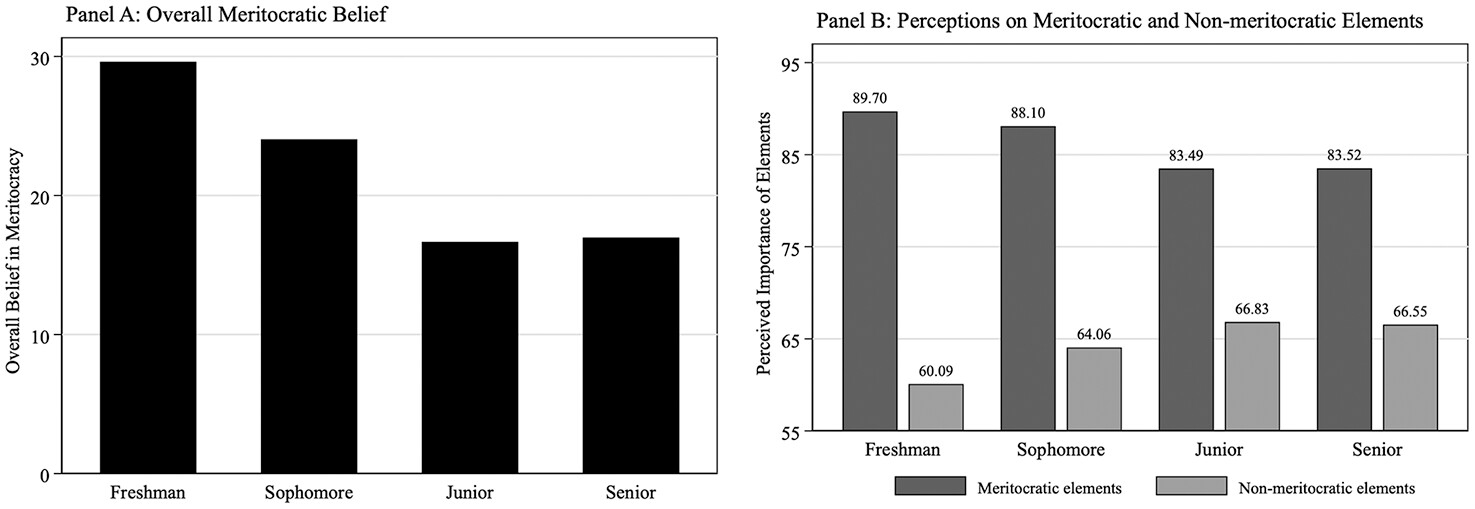
What the team found is more nuanced than a straightforward “loss of faith.” Overall, students still lean toward meritocratic interpretation for success. But as they move through college, their belief in meritocracy declines. Over time, they place less emphasis on meritocratic factors and increasingly recognize the role of other factors in shaping future career prospects. Results from students from families with lower socioeconomic status are especially revealing in this regard. They begin college less likely to emphasize the role family background and “guanxi” play, but gradually move closer to their peers from more advantaged socioeconomic backgrounds in acknowledging the importance of those factors.
Li sees that shift as deeply tied to students’ lived experiences of college. As students expand their social network and compare themselves with peers from very different backgrounds, they begin to see more clearly that effort alone does not explain success. Yet that realization does not erase their belief in hard work. “Most of them are oscillating between two narratives: on the one hand, they sincerely believe that hard work will be seen; on the other, they know that family background, social ties, and luck never really leave the picture,” Li said.
Li believes that tension is what makes the paper especially timely. “Public conversations about meritocracy often swing between two extremes nowadays—celebrating it as a fair ideal or dismissing it as a complete illusion,” he said. “Our study points to a more complicated reality. Students are not simply naive believers or hardened cynics. They are trying to reconcile personal agency with structural inequality, often while being shaped by both at once.”
The paper is first-authored by Tang Minghao, a third-year master’s student in Sociology in the NYU Shanghai - ECNU Joint Graduate Training Program. “The N.E.T. platform is indispensable for advancing sociological inquiry,” Li said. “It not only situates our students in the complexities of the Chinese context, but also equips them to engage with global scholarly conversations, increasing the intellectual presence of a young generation of Chinese scholars in leading international journals for social sciences.”