

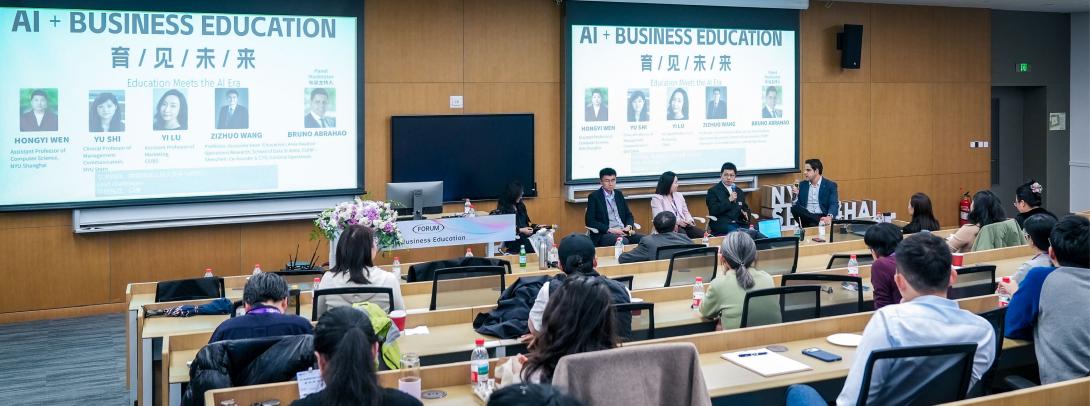
On March 18, NYU Shanghai’s Center for Business Education and Research (CBER) hosted the Forum on AI + Business Education, bringing together faculty and industry leaders to examine how artificial intelligence is transforming business education. Featuring four keynote presentations and a panel discussion, the forum focused on how leading institutions are integrating AI into curriculum design, teaching methods, and experiential learning to prepare students for an increasingly AI-driven world.
Nearly 150 participants representing academia and industry attended the event. Speakers from NYU Shanghai, NYU Stern, CEIBS, CUHK-Shenzhen, and Cardinal Operations shared perspectives on how business schools can move beyond responding to technological change and instead help shape new models of learning.
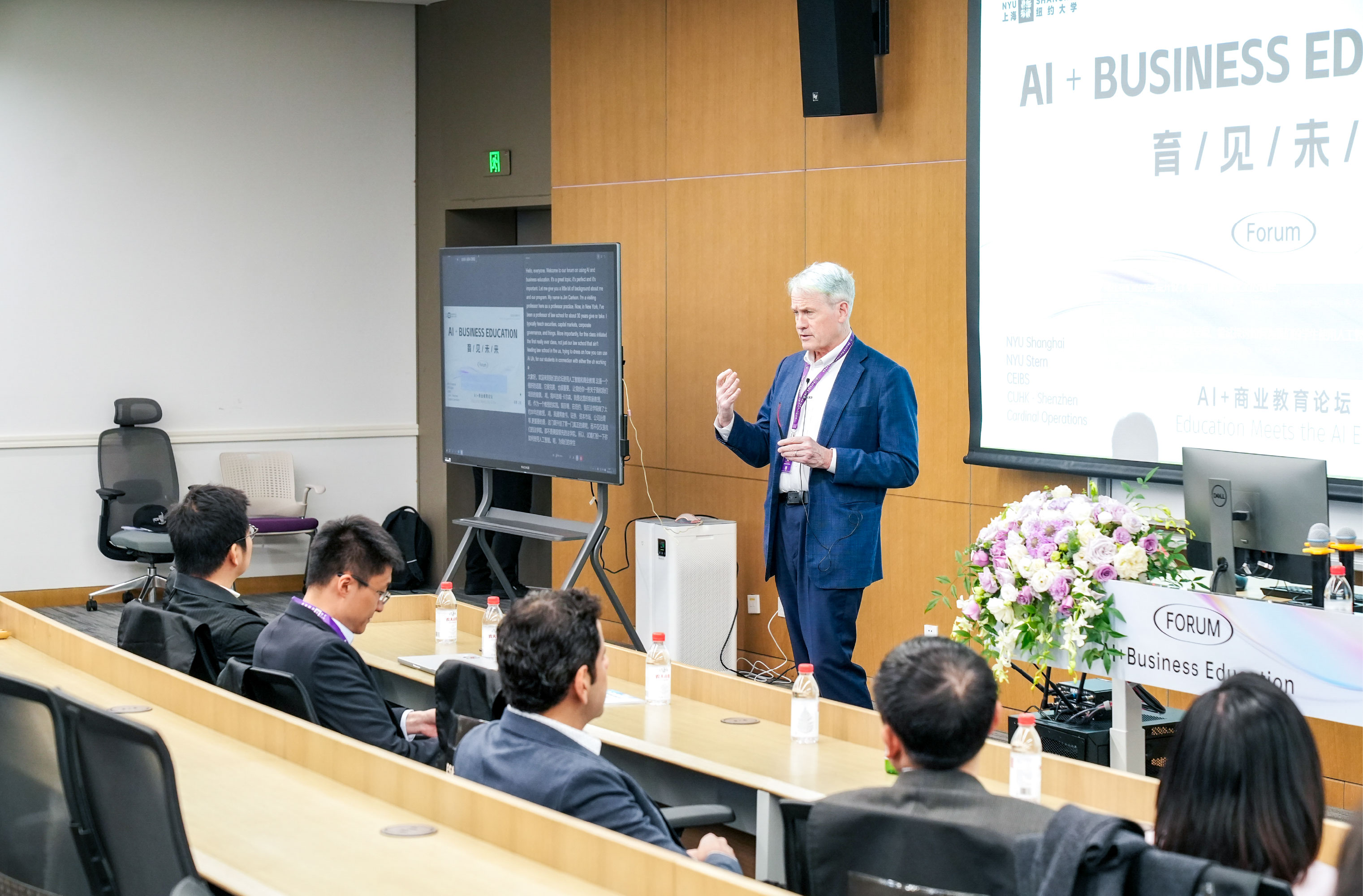
The forum was hosted by Visiting Professor of Practice in Business James B. Carlson who is also an adjunct professor of law at NYU School of Law. In his opening remarks, Carlson noted that while AI has generated extensive discussion and experimentation, meaningful implementation remains limited. Carlson emphasized that learning to work with AI is becoming essential not only for students, but also for future leaders navigating rapidly changing business environments.
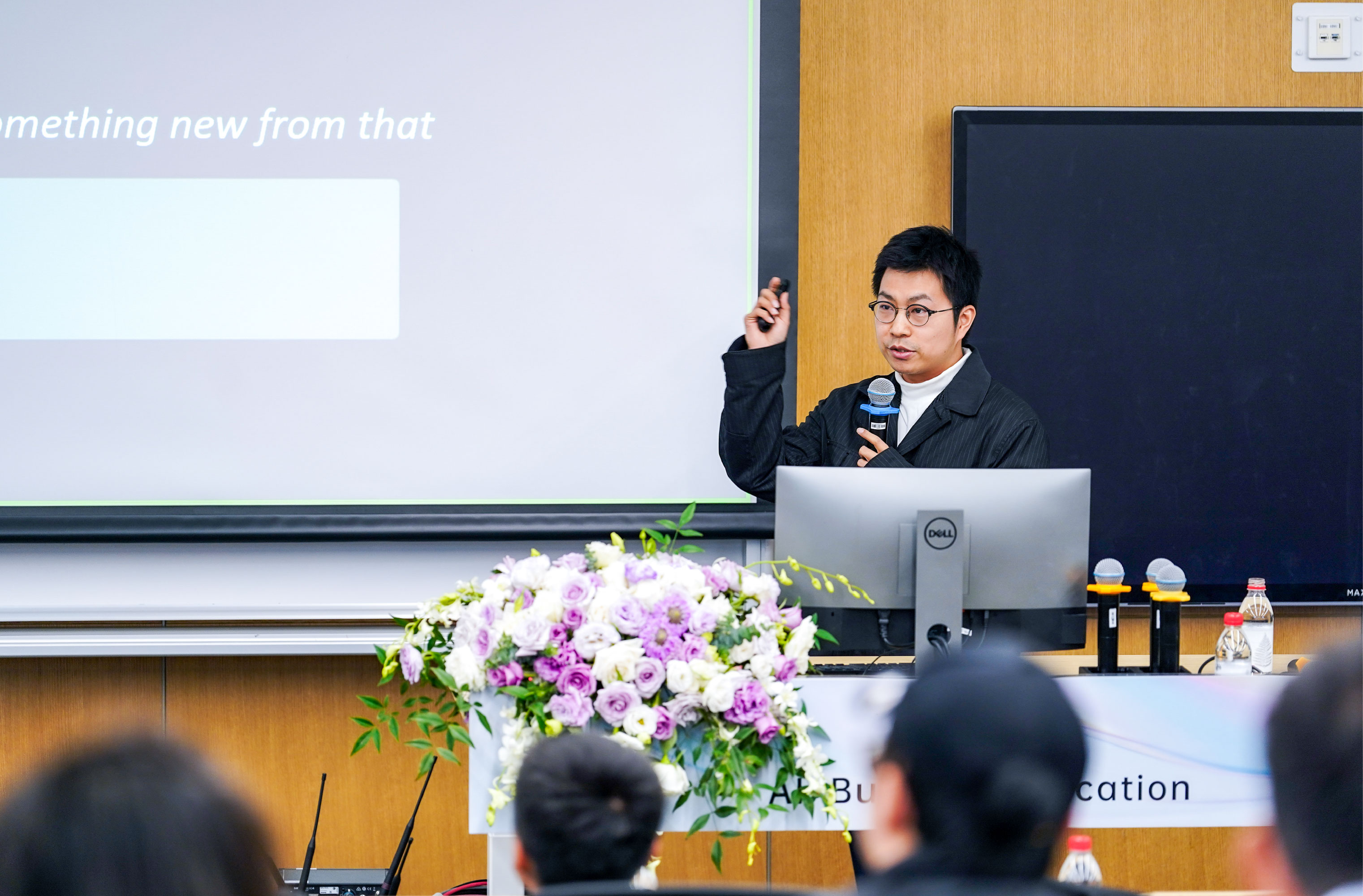
The first keynote was delivered by Assistant Professor of Computer Science Wen Hongyi on “Reimagining Education with AI: Towards Personalized Learning with AI for All.” Wen argued that the central question is no longer whether students will use AI, but how they will use it. He distinguished between passive delegation, in which students simply rely on AI to generate answers, and active collaboration, in which they use AI to test ideas, refine reasoning, and deepen learning. He suggested that educators should design learning experiences that position AI as a collaborator rather than a shortcut, and explored how personalized AI learning agents could support more adaptive and student-centered education.
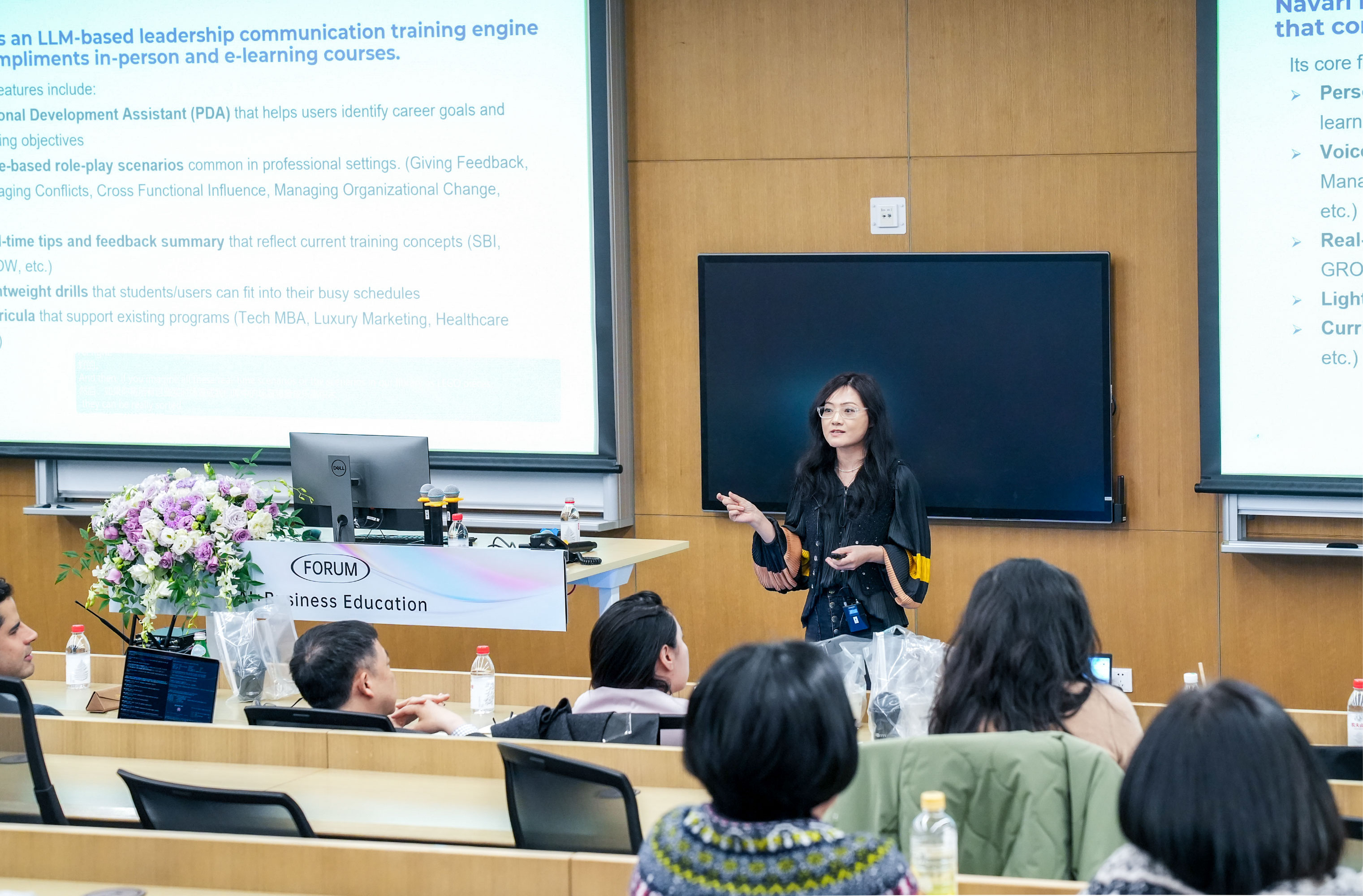
In the second keynote, “Engage + Scale: AI-Enabled Leadership Communication Training,” NYU Stern Clinical Professor of Management Communication and co-founder of Navari Yu Shi, focused on the role of AI in communication training. Shi introduced Navari, an AI-powered learning and development platform designed to help students practice leadership communication through immersive simulations, voice-based role play, and real-time feedback. Her presentation addressed a challenge familiar to many educators: how to provide meaningful practice and individualized feedback at scale. Shi showed how rather than replacing human instruction, AI can be used to extend experiential learning and help students build communication skills in more flexible and measurable ways.
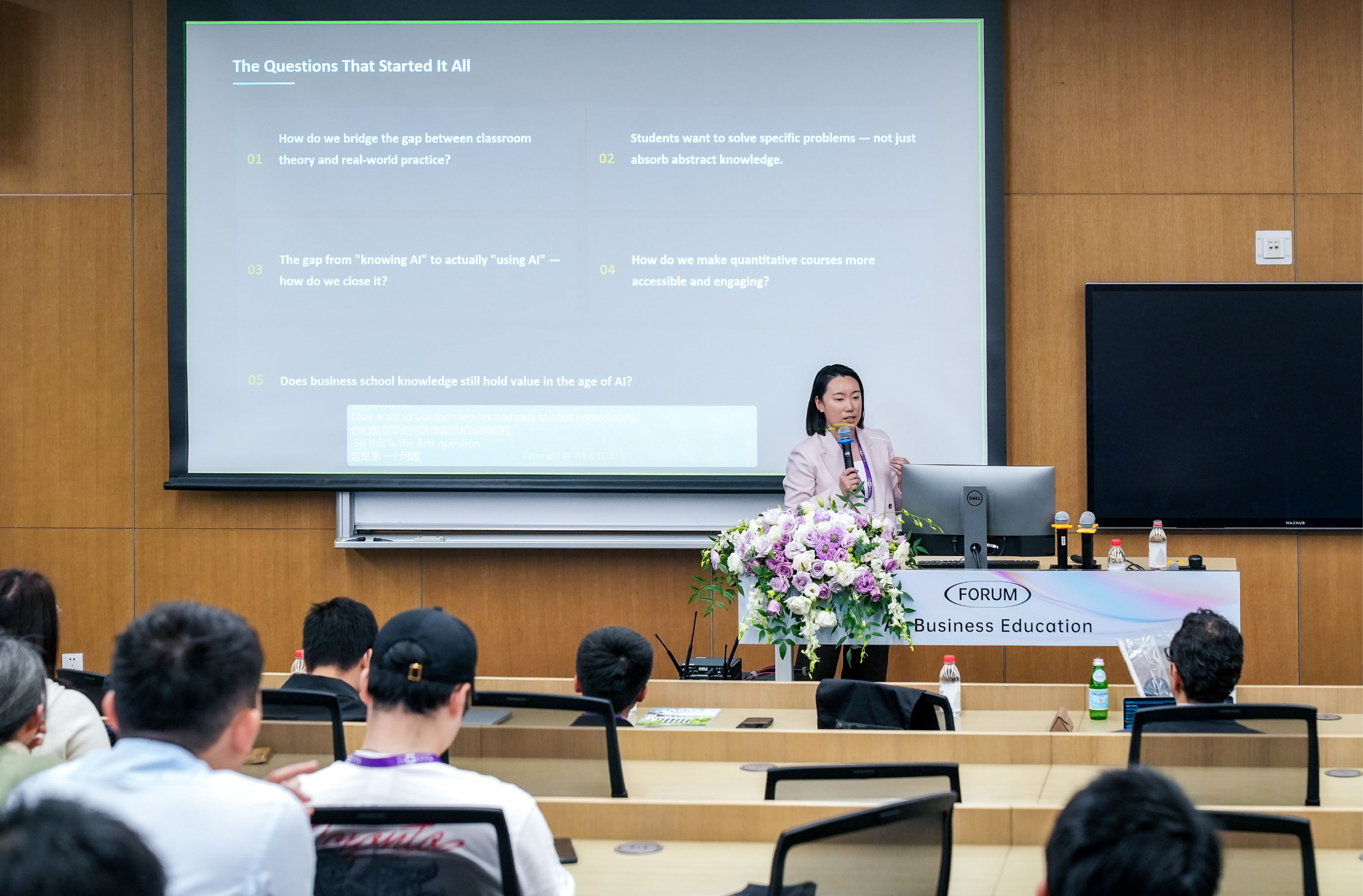
The third speaker, CEIBS Assistant Professor of Marketing Lu Yi, presented on “Building AI Agents for Teaching and Business Decision Making at the Executive Programs.” Lu discussed how AI agents can help bridge the gap between business theory and real-world practice, especially in executive education. Using examples from pricing and decision-making, she showed how AI can function not only as a technical tool, but also as a partner in reasoning, analysis, and application. She stressed that successful AI integration requires more than technology alone: it also depends on thoughtful course design, continuous refinement, and strong human-AI interaction.
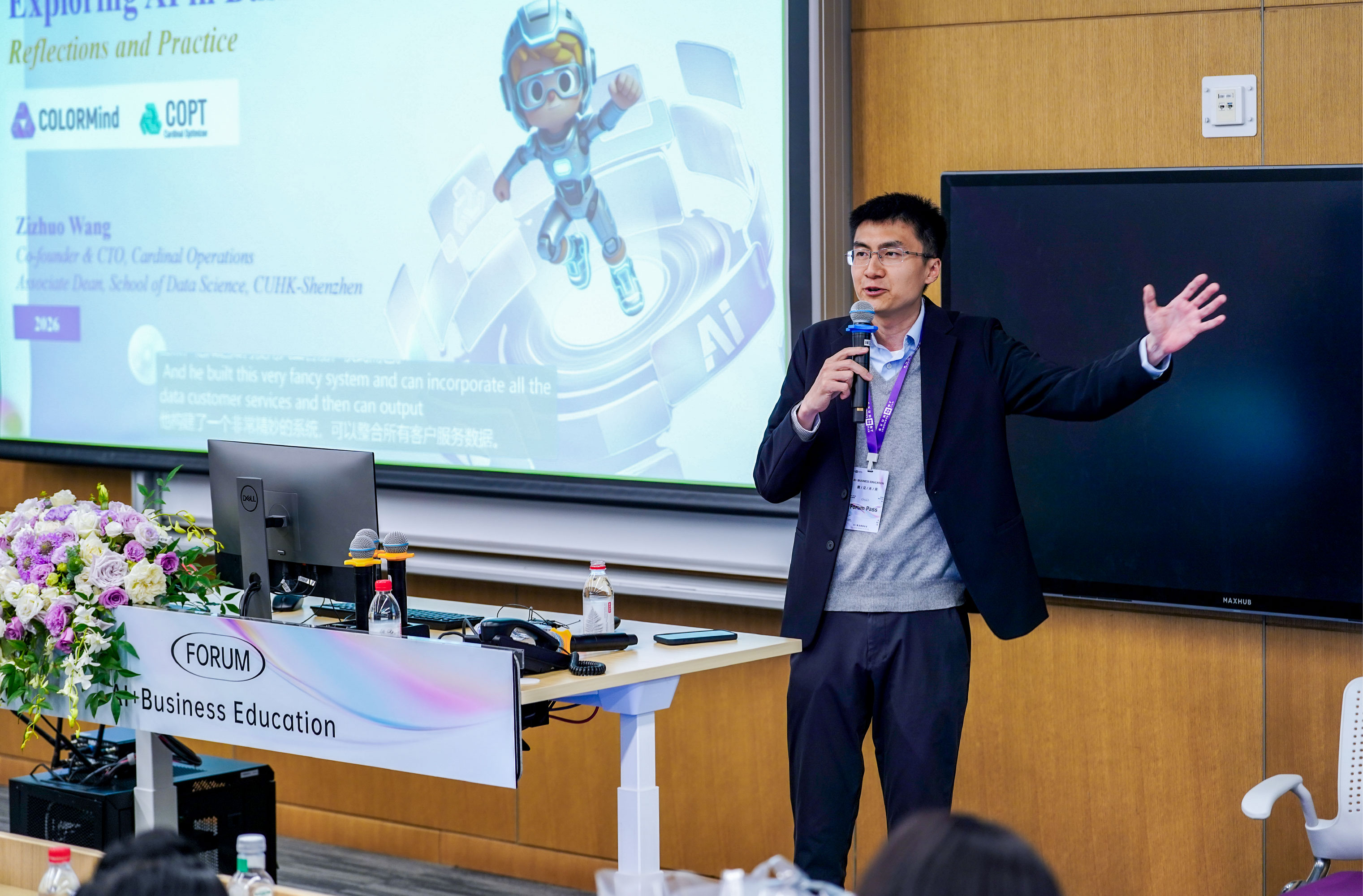
In the final keynote, “AI in Business Education: Exploration and Reflection,” CUHK-Shenzhen Professor and Associate Dean of Education Wang Zizhuo, who is also co-founder and CTO of Cardinal Operations, reflected on how AI is changing business decision-making and, in turn, what students need to learn. Wang argued that business education must move beyond knowledge transmission and place greater emphasis on experiential learning, problem solving, and collaboration with AI systems. He also highlighted the importance of preparing students from diverse backgrounds to develop both business judgment and technological literacy.
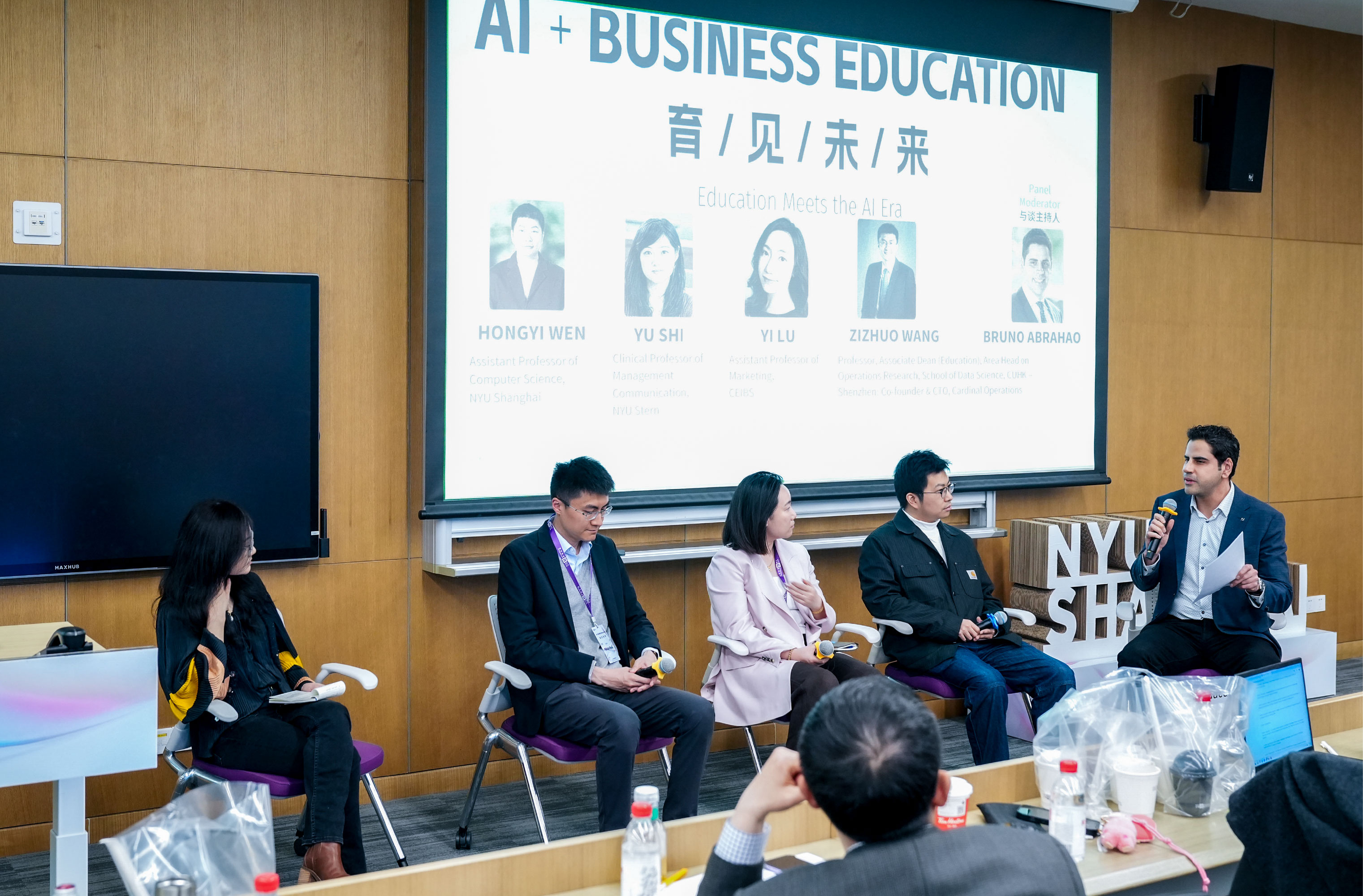
The keynote presentations were followed by a panel discussion moderated by Assistant Professor of Information Systems and Business Analytics Bruno Abrahao, which further explored how institutions can incorporate AI in ways that are practical, responsible, and pedagogically meaningful.
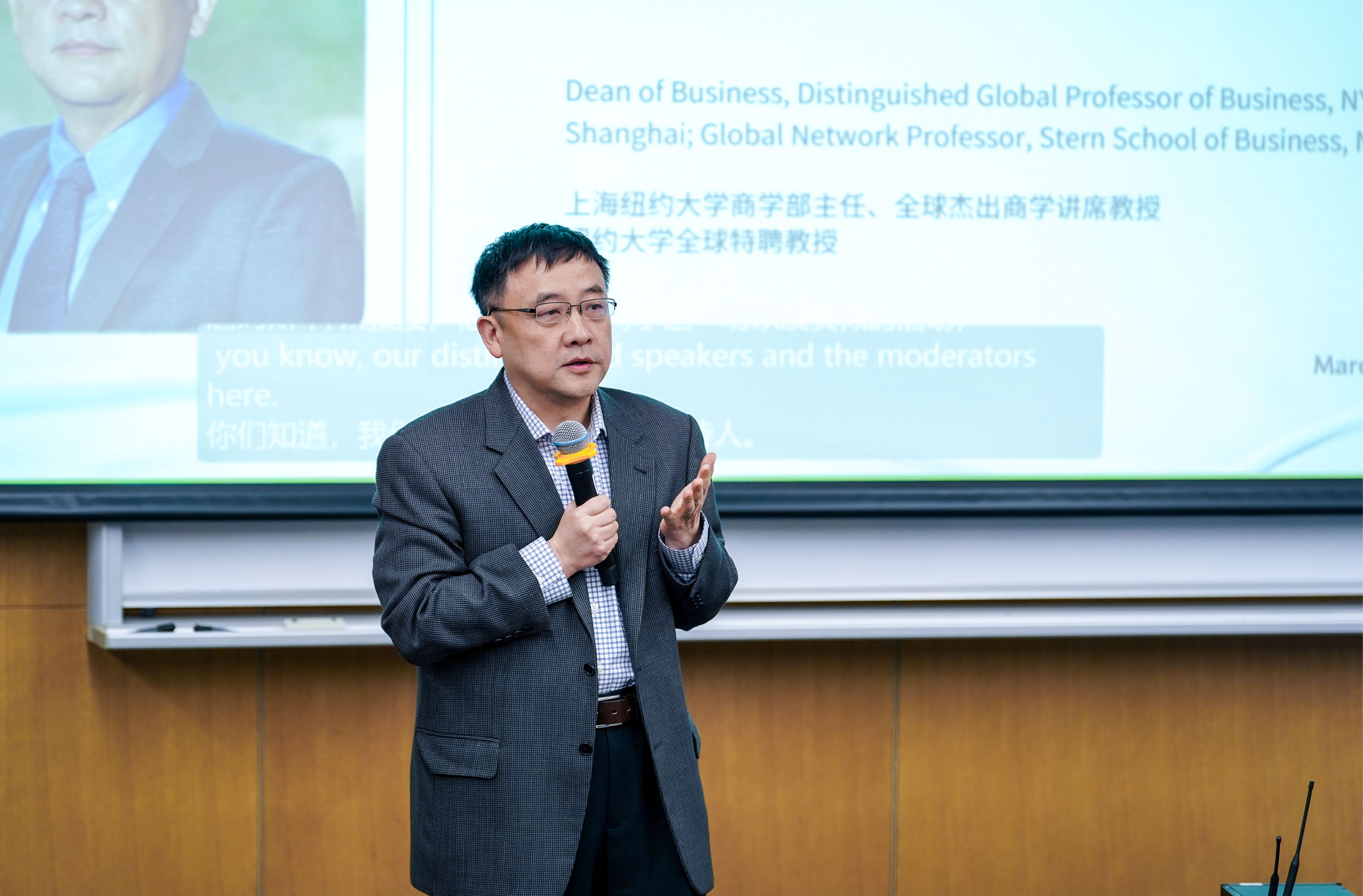
Closing the forum, Dean of Business and Distinguished Global Professor of Business Chen Yuxin reflected on what AI means for curriculum design. He emphasized that the rise of AI should push educators to reconsider not only what students should learn, but also what may no longer need to be taught in the same way. As AI becomes increasingly capable of storing information and producing answers, he said, educators must rethink curriculum to better fit the realities of the AI era. He expressed hope that the forum would encourage further reflection on how business education can evolve to meet that challenge.